
Strength, Load, and Intelligent Use of Props
For committed practitioners, teachers, and trainers, spinal health is not about avoiding challenge or defaulting to rest. It’s about understanding load, alignment, variability, and adaptation. Research consistently shows that the spine responds best to graded movement, intelligent strengthening, and exposure to multiple ranges, rather than prolonged protection.
Yoga practice is exceptionally well suited to this intent.
This article explores how practitioners can build spinal resilience, reduce recurring back pain, and extend the longevity of their practice. Table of Contents
What Evidence Says About Lower Back Pain
Current pain science and rehabilitation research agree on several key points:
- Most non-specific lower back pain is not caused by structural damage
- Avoidance and excessive protection often increase sensitivity and recurrence
- Progressive loading, movement confidence, and variability are protective
- Psychological and contextual factors (stress, fear, beliefs) influence pain outcomes
Taken together, this research reframes how we approach lower back pain in practice. Rather than treating pain as a signal to stop or protect the body indefinitely, contemporary evidence encourages informed movement and progressive exposure. When the spine is guided through a variety of ranges with appropriate load and attention to alignment, it adapts and becomes more resilient over time. Equally important is the role of psychological and contextual factors — stress, fear, and belief systems can amplify pain responses, while confidence, education, and supportive teaching environments help reduce them.
Yoga already addresses many of these principles, and yoga props enhance our capacity to:
- Modify load rather than remove it
- Improve force distribution
- Maintain spinal integrity under challenge
- Train range with control instead of collapse
Using props is less about making poses “easier” and more about expanding our experiential and therapeutic capacity within practice.
Props as Tools for Intelligent Load Management
In advanced practice, props function less as “support” and more as feedback and load regulators.
- Blocks refine leverage and reduce unnecessary spinal shear
- Belts allow controlled range under tension
- Mats influence proprioception and joint loading during sustained work
In Iyengar-informed practice especially, props are used to increase clarity and precision, not reduce demand.
An Evidence-Informed Yoga Sequence for Lower Back Health
This is not a “pain relief” sequence. It’s a spinal training sequence.
1. Tadasana with Block Feedback
Focus: Axial extension, load distribution
- Block between thighs to engage adductors and pelvic support
- Emphasis on spinal stacking and ground reaction force
Why it matters: Standing alignment sets the tone for spinal loading in all movement.
2. Uttanasanawith Block Support (Active)
Focus: Controlled spinal flexion
- Blocks under hands to prevent collapse
- Emphasis on hamstring length without lumbar dumping/relaxation
Evidence link: Graded spinal flexion improves tolerance and confidence in forward movement.
3. AdhoMukha Svanasana (Downward Dog / Summit) with Belt
Focus: Spinal traction under load
- Belt around upper thighs to stabilise pelvis
- Active press through hands and length through spine
Why it matters: Builds spinal endurance and traction while distributing load across limbs.
4. VirabhadrasanaI or II with Block
Focus: Lumbopelvic control under asymmetrical load
- Block under back heel or between hands
- Emphasis on neutral spine under challenge
Teacher lens: This is where back pain often emerges > props expose faulty strategies.
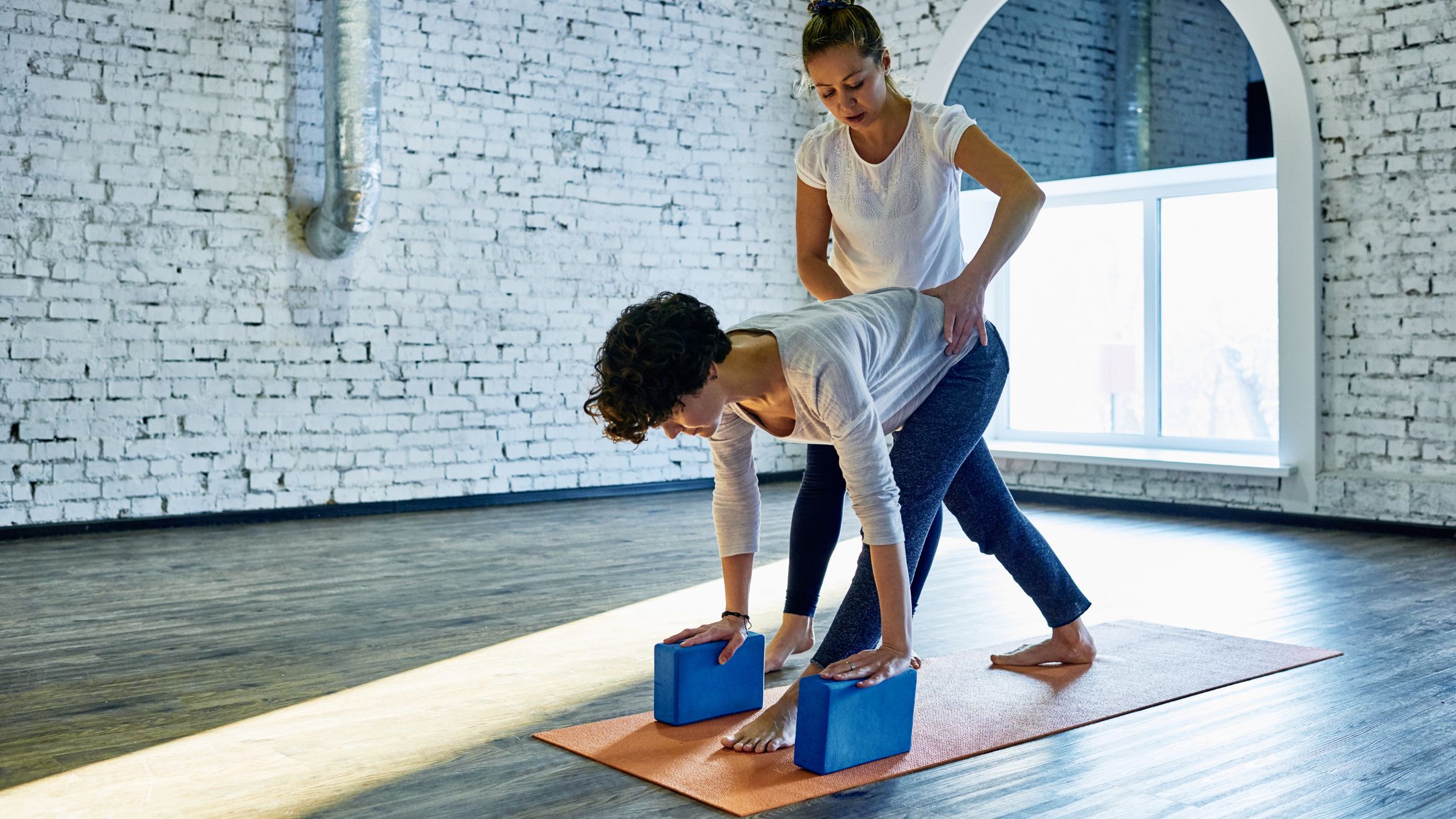
5. Parsvottanasanawith Blocks
Focus: Hip–spine dissociation
- Blocks prevent over-reliance on lumbar flexion
- Encourages posterior chain loading with integrity
6. ShalabhasanaVariations
Focus: Posterior chain strength
- Block between thighs to prevent over-compression
- Short, controlled lifts with breath awareness
Evidence: Back extensor endurance correlates strongly with reduced recurrence of LBP.
7. Seated Twist with Height
Focus: Axial rotation without compression
- Sit on block or folded blanket
- Emphasis on spinal length before rotation
Why This Works Long Term
This approach builds movement confidence, trains the spine through multiple ranges, and reduces fear-based avoidance patterns often associated with back pain. Rather than focusing solely on symptom relief, it supports teaching longevity and long-term practice sustainability. For practitioners, teachers, and studio owners alike, it models a practice that is safe, intelligent, clinically relevant, and adaptable over time.Yoga King Props for Serious Practice
Yoga King props are designed for durability, precision, and repeated use, whether in teacher training, studio classes, or personal practice.
- Cork blocks for stability and tactile feedback
- High-density bolsters for structural support
- Quality belts for controlled range and load
- Mats that support long holds and grounded work
Lower back pain doesn’t require avoidance or over-correction. Intelligent yoga practice, supported by the right props, can reduce symptoms and support long-term spinal health.
🌿 Explore Yoga King’s yoga props → https://www.yoga-king.com/props.html
References
- Hartvigsen J. et al. (2018). What low back pain is and why we need to pay attention. The Lancet, 391(10137), 2356–2367.
- O’Sullivan P. et al. (2016). Cognitive Functional Therapy: An integrated behavioural approach for the management of chronic low back pain. British Journal of Sports Medicine, 50(16), 978–987.
- McGill S. (2010). Core stability, evidence and clinical application. Journal of Bodywork and Movement Therapies, 14(1), 2–13.
- Moseley G.L. & Hodges P.W. (2012). Are pain and movement control related? Clinical Journal of Pain, 28(8), 658–663.
- Cramer H. et al. (2013). Yoga for chronic low back pain: A meta-analysis of randomised controlled trials. Clinical Journal of Pain, 29(5), 450–460.