
There is a point in practice where effort alone stops being the answer. In a posture like Trikonasana (Triangle Pose), the initial experience is often one of strength: legs working, arms extending, attention focused. Yet if we stay there, relying purely on muscular effort, the pose gradually becomes dense. The breath shortens, the body begins to grip, and what was once steady starts to feel forced.
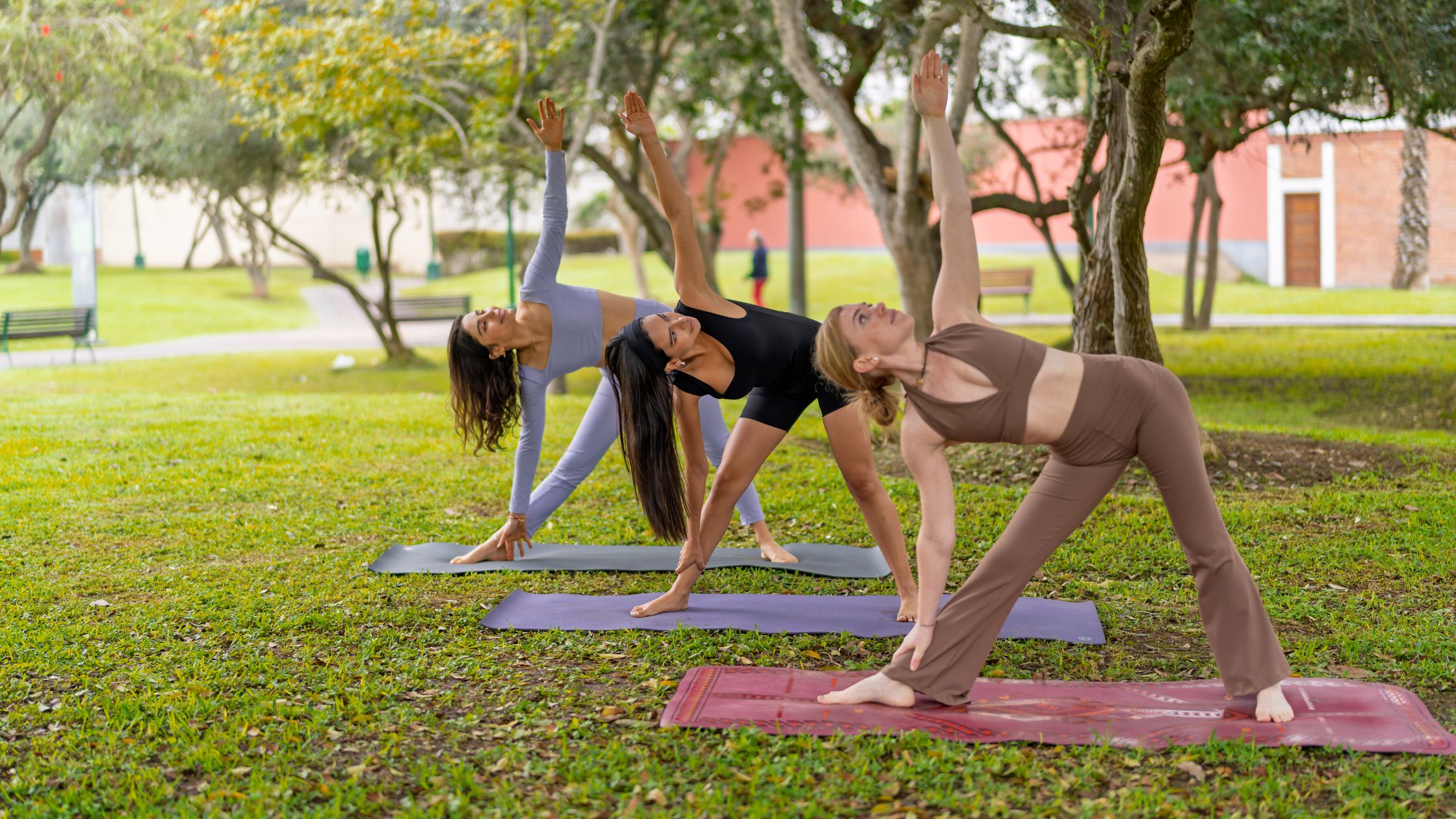
Table of Contents
This is where Triangle Pose becomes more interesting. Beneath the visible shape, it asks a more subtle question: how are you relating to the forces acting on your body?
Gravity is always present in practice, but it is rarely explored directly. More often, we respond to it unconsciously, either by giving way to it or by resisting it. In both cases, the body loses its capacity to organise itself efficiently.
If we observe closely, three distinct patterns tend to emerge.
Typical Movement Patterns
One is a tendency to collapse, where the body yields without structure. Weight drops into the joints, muscular tone diminishes, and the posture becomes heavy. Breath follows this pattern, often feeling restricted or dull, as though the internal space of the body has been compressed.
Another is the impulse to push. The feet press firmly into the ground, the muscles engage strongly, and the body is held upright through effort. There is a sense of control in this, but also a certain rigidity. The breath often rises higher into the chest, and the longer the pose is held, the more this effort accumulates as tension.
Between these two is a more refined possibility. Yielding, in this context, is not a withdrawal of effort but a reorganisation of it. The body allows its weight to be received by the ground while maintaining enough tone to preserve structure. When this balance is found, the quality of the posture changes. Effort becomes more evenly distributed, and the breath settles into a deeper, more sustainable rhythm.
Let’s explore this principle in Triangle Pose.
Strength, Support, and Intelligence
In Trikonasana, the shape appears deceptively simple. The legs are straight, the torso lengthens over the front leg, and one hand lowers toward the shin, ankle, or a prop. Yet the experience of the pose varies dramatically depending on how weight and effort are organised.
A common approach is to reach down as far as possible, prioritising depth over structure. In doing so, the lower side body shortens, the chest rotates downward, and weight begins to drop into the front hip and knee. This is the pattern of collapse expressing itself in a more subtle form. The posture may look complete from the outside, but internally it feels compressed, with the breath losing its natural ease and depth.
At the other end of the spectrum, the pose is held together through effort. The legs grip, the torso is held rigidly in place, and the top shoulder is pulled back with determination. There is clarity in the shape, yet the effort is localised and often excessive. The breath reflects this, becoming contained and slightly strained, particularly through the upper chest and neck.
Triangle Pose becomes more stable, and more comfortable, when these two tendencies are refined into something more balanced.
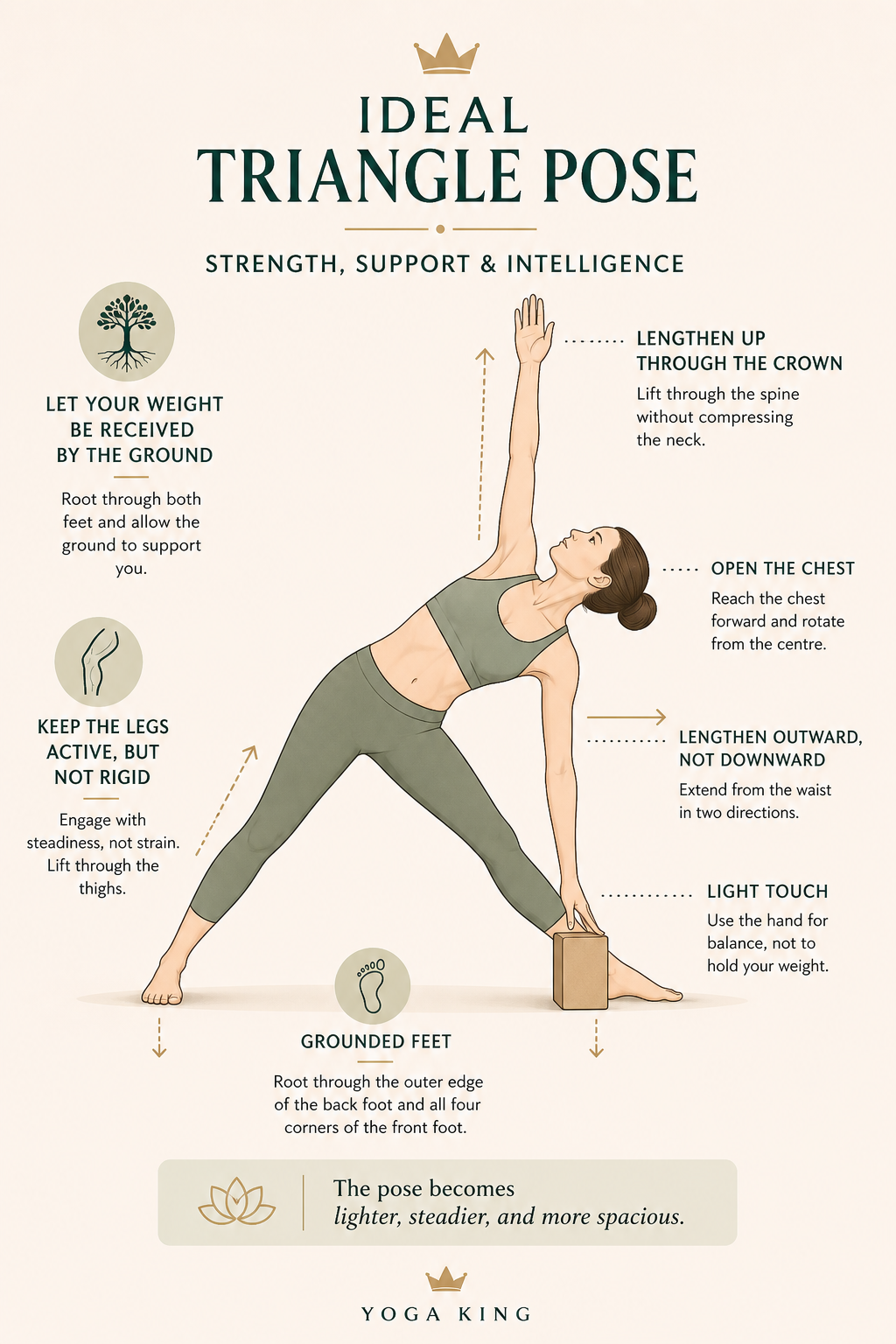
From your base, begin by establishing a steady connection through both feet. The front foot roots evenly, while the back foot anchors the pose with gentle firmness. Rather than pushing down forcefully, allow the weight of the legs and pelvis to be received by the ground. This initial act of receiving creates a sense of support that does not rely on gripping.
From here, the movement into the pose can unfold with more ease. As the torso extends over the front leg, the emphasis shifts from reaching downward to lengthening outward. The lower side body remains spacious, the ribcage broad, and the spine feels as though it is being drawn in two directions at once: toward the ground and toward the horizon.
Placing the lower hand becomes a secondary consideration. Whether it rests on the leg, the floor, or a block or chair, its purpose is not to hold the body up, but to receive a portion of its weight. When the hand bears too much load, the shoulder compresses and the pose loses its integrity. When the weight is shared more intelligently through the legs and the base, the upper body remains lighter and more responsive.
The upper arm and chest can then open with less effort. Rotation arises from the organisation of the whole body, rather than from pulling the top shoulder back. The neck and gaze follow naturally, without strain.
Breath offers a clear reflection of this process. When the pose is forced or over-held, breathing becomes restricted, particularly along the shortened side of the body. As the structure becomes more balanced, the breath begins to move more freely across the ribs and into the back of the body. There is a sense of continuity, as though the breath is able to travel through the entire shape rather than being confined to one area.
Grounding and Expansion in Practice
What emerges in this version of Triangle Pose is a relationship between grounding and expansion. The more clearly the body surrenders its weight into the ground, the more naturally the spine and chest can extend, in one steady, continuous movement.
It can be useful to explore this directly in practice. Move into the pose and allow yourself to exaggerate the familiar patterns, first collapsing slightly into the lower side, then holding the posture with strong, deliberate effort. From there, gradually refine toward a middle ground where the weight is supported, the muscles are active but not rigid, and the breath remains unforced.
Over time, this develops a more nuanced understanding of how the body organises itself in space. Triangle Pose becomes less about achieving a particular depth or appearance, and more about sensing how support is received and expressed.
In this way, the posture offers something beyond flexibility or strength. It becomes a way of studying how effort can be applied with precision, and how ease can arise not from doing less, but from doing what is necessary with greater clarity and intelligence.